

B. Scott Crawford Talk: Navigating the Jagged Frontier in the 19th Century and What it Teaches us Today
RSVPs are strongly encouraged – see below to save your spot!
Lilly Martin Spencer supported her husband and children through her work as an artist at a time when a woman doing so defied nearly every expectation placed on her — and at the moment a new technology began dismantling the trade she fed them with. “There is no poorer business than that of an artist,” she wrote to her parents in December 1859. “Photographing is destroying portrait painting.” She had not had a portrait to paint in a year.
She never made peace with it. Three years earlier she had called photography “machine work,” and watched cheap manufactured canvases sold by the crate at auction to a public that, she said, could not tell the difference. She was still complaining to her mother about it at the end of the decade.
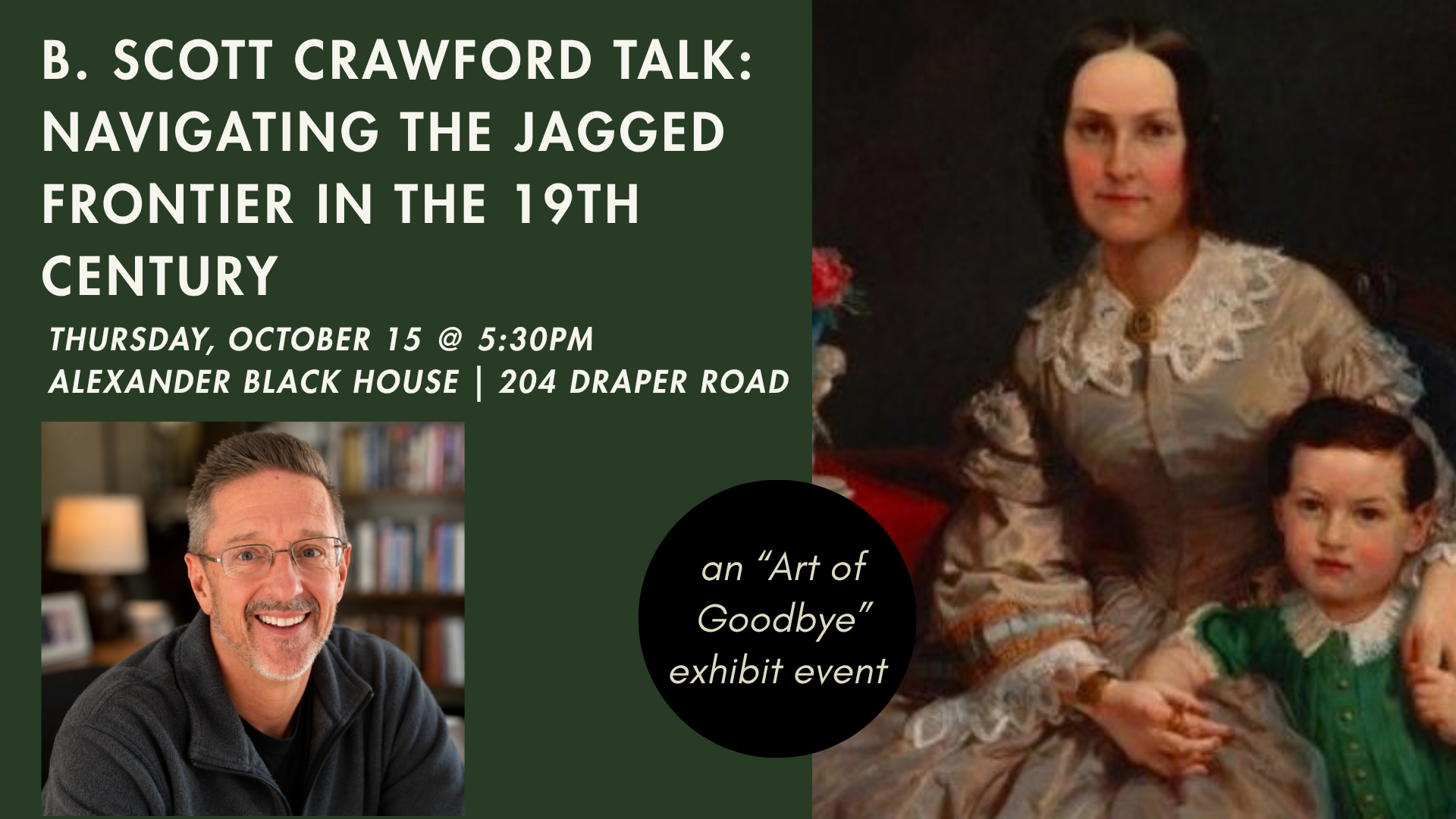
And, yet, she used photography anyway. Photographs reached her by mail from clients she would never meet, and she turned them into paintings — a market no portrait painter before her could have reached. Her portrait Jane Eleanor Sherman Lacey and Her Son Edward, ca. 1857, now in the collection of the Taubman Museum of Art, is the clearest surviving evidence of that practice: a mother and her six-year-old son, both already dead when she painted them, worked up from photographs sent to her studio, with a third lost child carried in the mourning brooch worn by Jane. It is the only identified posthumous portrait by Spencer with more than one deceased sitter – and continuing the clue as to how she crated the work; a work that without “machine work” could not have ever been created.
B. Scott Crawford, who identified the painting as a postmortem portrait and followed its subjects from Roanoke to Bridgeport, Connecticut, will use it to examine the “Jagged Frontier” — a term from recent research on human–AI collaboration, describing the shifting boundary between what a machine can do and what only a person can. His argument is that the frontier we are told is unprecedented has been crossed before, and that Spencer, who loathed the technology, needed the money, and made from it something no camera could produce, is a better guide to it than most of what is written today. Along the way he will explain how a nineteenth-century painter came to give a twenty-first-century CEO a measure of solace.
B. Scott Crawford serves as President & CEO of Virginia 811, the nonprofit notification center regulated under Virginia’s Underground Utility Damage Prevention Act. The organization processes roughly 1.6 million locate requests annually, connecting excavators with utility operators to preserve life and property and protect the Commonwealth’s underground utility infrastructure. He joined Virginia 811 as Director of Operations in 2016, was named Vice President in 2018, and has led the organization since 2020. Under his leadership, Virginia 811 moved to a fully remote work environment and has leveraged artificial intelligence, augmented reality, and geospatial technology to drive damages down.
His path to damage prevention was anything but linear. He began as a history teacher in Roanoke City Public Schools, earning National Board Certification in 2002, before serving as the division’s K-12 Social Studies Coordinator. As Director of Education at the Taubman Museum of Art, he joined the senior team as the museum opened a $66 million facility and designed a web-based art interpretation tool that drew international attention. He later built nationally recognized professional development programs for the credit union industry, earning two national awards, and has taught as an adjunct instructor at Virginia Western Community College, Radford University, and Virginia Tech.
The humanities remain central to his approach to leadership. Crawford holds an M.A. in Colonial American History from Old Dominion University and a B.S. in History from Radford University, and has published on colonial Virginia, Machiavelli, and nineteenth-century American painting; his research prompted the National Gallery of Art to retitle a work in its collection.
I'd Like to Attend!
Due to the exhibit that will be installed during, and as part of, this event, we need to cap attendance at 35.